Factory-Direct Shipping NationwideLive UPS & Freight Rates at CheckoutNet Terms & Purchase Orders for Business AccountsReal Material Handling Experts — Premier Handling Solutions
Shop by Department
The Best Rolling Ladders in 2026: Picks by Height and Duty
Seven rolling ladders from a $74 two-step to a 15-step cantilever — with a step calculator that sizes the ladder to your shelving.
By MaterialHandling.com Product Specialists • Published September 23, 2026 • Updated September 23, 2026
Prices and stock on this page are pulled live from our
inventory system — they reflect what you'd pay right now.
How we chose these picks
We selected by height band and duty, using manufacturer-published specs (top-step height, load rating, step geometry, ANSI duty type where published). All seven picks are Ballymore — a US ladder specialist whose spring-loaded caster design is the industry default: the ladder rolls freely when unloaded, and the moment a worker steps on, the casters compress and rubber-tipped legs plant on the floor. We carry many ladder brands; Ballymore swept this list on spec coverage and consistency, not on placement — no placement is paid. Availability badges are live.
Rolling ladders (safety ladders with spring-loaded casters) are how warehouses reach above 6 ft hundreds of times a day without staging scaffolds or misusing step stools. The engineering that matters: top-step height (your feet, not your hands), step depth and angle (fatigue on frequent climbs), and load rating (the worker plus what they carry).
Rule of thumb we use below: a worker standing on a step comfortably works about 66 inches above it. Use the calculator to translate your highest shelf into a step count, then match the picks — from a two-step under $75 to a 15-step cantilever that reaches over obstructions. Prices and stock are live.
How many steps do you need?
Enter the highest shelf or surface a worker must comfortably reach. We assume a standing overhead reach of 66 inches above the step you stand on (a conservative figure for shorter team members) and the industry-standard 10-inch step rise. This is a sizing estimate — check the exact top-step height in the comparison table before buying.
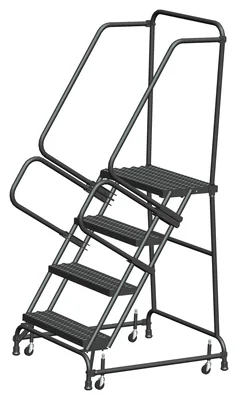
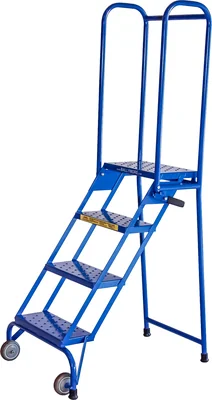
1. Ballymore Spring-Loaded Caster 4-Step Rolling Ladder, 30" base, 14" top step
by Ballymore — Model FSH426P
Best for: everyday stockroom and warehouse access
The FSH426 is the configuration most warehouses should default to: 4 steps with a handrail, 450-lb rating, a deep 14-in. top step, and 24-in.-wide steps that feel secure in work boots. It's ANSI-certified, made in America, and powder-coated. At 73 in. overall height it reaches the shelf band most sub-8-ft operations live in.
Pros
Handrail comes standard — many 4-steps charge extra
Wide 24 in. steps and a 14 in. top step
ANSI certified, US-made
Cons
Too short for shelving above ~9 ft — size up
Steel weight; this rolls between aisles, it doesn't carry upstairs
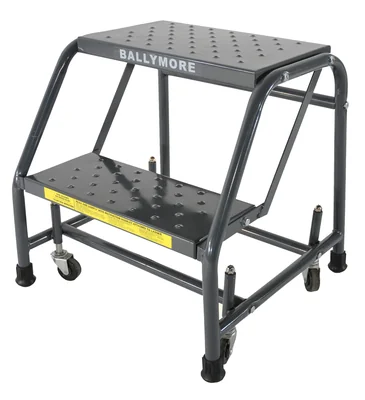
2. Ballymore Spring-Loaded Caster 2-Step Rolling Ladder, 20" base, 10" top step, no handrails
by Ballymore — Model 218P
Best for: low shelving and counter-height access
At $73.98 the two-step 218 is the cheapest spring-loaded-caster ladder we sell, and it's not a toy: 450-lb rating — same as ladders ten times the price — 16-in. steps, a 10-in.-deep top step, US-made steel. For grabbing stock at 7–8 ft reach heights it does everything the big units do.
Pros
Full 450 lb rating at an entry price
Compact 19 x 20 in. footprint tucks anywhere
Same spring-caster safety mechanism as the big ladders
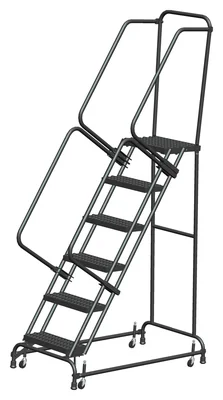
3. Ballymore Spring-Loaded Caster 6-Step Rolling Ladder, 26" base, 14" top step
by Ballymore — Model FSH618P
Best for: reaching the 11-13 ft shelf band
The 6-step FSH618 extends the same ANSI-certified, handrail-equipped formula as our top pick to 93 in. overall — putting comfortable working reach around 11–12 ft. 450-lb rating, 14-in. top step, spring-loaded casters, made in America. If the calculator said 5 or 6 steps, this is the pick.
Pros
Handrail and 450 lb rating at 6-step height
14 in. top step is a stable perch at altitude
ANSI certified, US-made
Cons
16 in. step width — narrower than the 4-step pick
Footprint grows with height; check aisle turning room
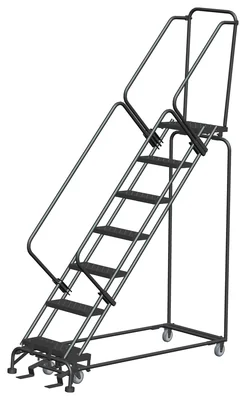
4. Ballymore 50° Stairway Slope 7-Step Rolling Ladder, 24" base, 14" top step
by Ballymore — Model SW724P
Best for: pick operations with dozens of climbs per shift
The SW724 is a 7-step at a 50° slope with 10-in.-deep steps — workers walk down facing forward instead of backing down a steep flight. Top step sits at 70 in., overall height 103 in., 450-lb rating, US-made. For high-frequency picking, the gentler geometry is the difference between a ladder people use correctly and one they rush.
Pros
50° walk-down slope — descend facing forward
Deep 10 in. steps reduce fatigue on repeat climbs
70 in. top step covers the 11-13 ft reach band
Cons
68 in. base depth — the gentle slope costs floor space
5. Ballymore Lock-N-Stock 4-Step Aluminum Rolling Ladder, 24" base, 10" top step, perforated tread, factory setup
by Ballymore — Model ALS42410
Best for: maintenance carts, service vans, multi-site work
The Lock-N-Stock ALS42410 folds flat and is aluminum, so one person lifts and stows it — the pick for maintenance techs who bring the ladder to the job. 4 steps to a 38-in. top step, casters for rolling, 24-in. step width, 28-in. handrails. Rated 300 lbs: plan for worker plus tool bag, not worker plus product case.
Pros
Folds flat — transportable in a van or on a cart
Aluminum build one person handles easily
Handrails standard at 4-step height
Cons
300 lb rating is the lowest in this guide
Aluminum flexes more than steel under heavy movement
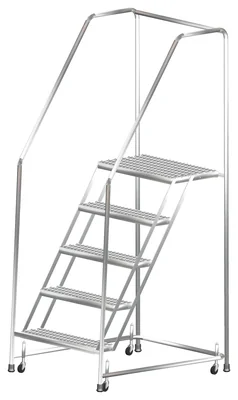
6. Ballymore 5-Step Stainless Steel Rolling Ladder, 20" base, 14" top step
by Ballymore — Model SS520P
Best for: washdown areas and corrosive environments
The SS520 is a 5-step in stainless steel — the spec for food plants, pharma suites and washdown zones where painted steel rusts and sheds. Type 1AA duty rating (the highest ANSI class published in this guide), 450-lb capacity, 50-in. top step, made in America. Stainless costs real money; it's the right money where hygiene audits happen.
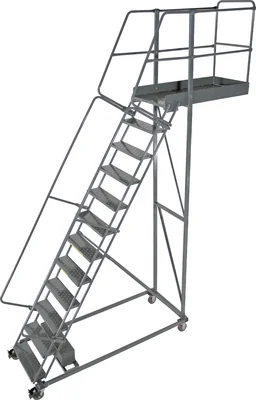
Best for: reaching over conveyors, machines and racking
The CL-15-42 is a 15-step cantilever: 186 in. overall with a 42-in. platform that overhangs obstructions — conveyor lines, machinery, staged pallets — that no straight ladder can approach. 36-in. handrails around the platform, Type 1A duty, 147-in. vertical clearance under the cantilever, 300-lb rating. This is a serious piece of access equipment; measure your application before ordering.
Pros
Cantilever platform reaches over obstructions
Guarded 42 in. platform for extended work at height
Type 1A duty rating, US-made
Cons
300 lb rating — worker plus tools, mind the math
103 in. base depth needs real floor space to maneuver
Climb frequency changes the answer. A standard 59° ladder is fine for occasional access; if pickers climb dozens of times per shift, a 50° slope walk-down design lets them descend facing forward — faster and dramatically less fatiguing. Carrying loads? Handrails stop falls when hands aren't free; deep top steps (10–14 in. on these picks) give a stable perch. Environment matters: stainless construction for food and pharma washdown areas, aluminum where the ladder gets lifted or folded daily. Over obstructions: a cantilever design overhangs conveyors and machinery that a straight ladder can't approach. All seven picks are US-made.
Frequently Asked Questions
What does the 450 lb rating actually cover?
Worker plus everything they carry and wear — tools, picked product, PPE. The 450-lb picks here leave generous margin for a heavy picker carrying a full tote; the 300-lb-rated aluminum and cantilever picks deserve a moment of arithmetic before you buy.
How do spring-loaded casters work, and are they safe?
Unloaded, the ladder rolls on four casters. When someone steps on, their weight compresses the springs and the ladder settles onto fixed rubber-tipped legs — it physically cannot roll while occupied. It's been the standard warehouse ladder mechanism for decades.
What's the difference between a 59-degree and 50-degree ladder?
The climb angle. Standard ladders are ~59 degrees — compact footprint, but you descend facing the steps. A 50-degree 'slope walk-down' ladder has deeper steps (10 in. on our pick) at a gentler angle, so workers walk down facing forward. For high-frequency picking it's a meaningful fatigue and safety upgrade at a modest price premium.
Do these ladders meet OSHA requirements?
OSHA's walking-working surfaces rule (29 CFR 1910.23) covers mobile ladder stands: capacity, step uniformity, and guarding on platforms above certain heights. The picks here are built to those requirements, and several carry published ANSI duty-type ratings (noted in the comparison table). Verify the configuration matches your use — especially handrail needs when workers carry loads.